Tuesday, October 15, 2013

From Ben Granderson: Eihoh Hosoe - Kamaitachi


Aesthetic and Symbolic Uncanniness

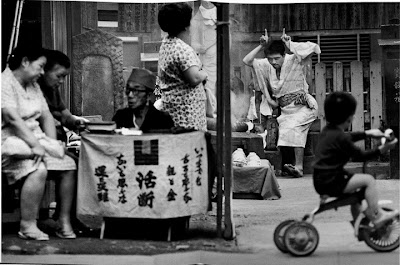
This photographer that made this image is Eihoh Hosoe and the man making the horns is Tatsumi Hijikata. The image is taken from a larger narrative of images that makes up a book called Kamaitachi.
The Kamaitachi was a mythical weasel creature that moved at lightning speed and cut the legs of farmers as they worked the fields. Others believe it was the vacuum created by a dust devil that would cut the farmer. Over the course of three years, Hosoe and Hijikata created an evocative narrative focused around the person moving from the city to the country-side. And as they moved they swept into the country-side like two Kamaitachi’s, producing images that were uncanny and evocative.
Hijikata in the book, which is comprised entirely of images is supposed to be a Kamaitachi and the representation of the post WW2 Japanese man’s mindset, confused and obliterated after having Western ideology destroy much of the country’s imperialistic cultural mindset. As Hijikata descends upon a remote village he slices open the world and the lives of the people and landscape around him like a Kamaitachi and through Butoh style dancing and expressive acting he exposes his and Hosoe’s views of life post WW2 realized in a contradictory state in rural Japan. Hijikata hides in fields, runs like the wind and acts with the locals. Sometimes they don’t see him as he watches them from rooftops or in sheds, other times he hides alone in the dark crying. Interspersed are images of Hijikata involved in sexual with young Japanese girls. Eventually, we lose track of what or who Hijikata is in the story. All we have to go on are the short explanations and texts from Hosoe and the editors of the book; we are left with the rest.
The photos become uncanny and surreal because of the evocative nature of Hijikata’s actions and Hosoe ability to capture an image at the moment when Hijikata transforms into the Kamaitachi. In Butoh, the actor does not pretend or act like the thing in mind, he or she becomes the thing and lets it out naturally, they don’t suspend their objecthood or hide behind it, they become it entirely. When Hijikata became the Kamaitachi, he was the mythical creature, and in turn, was able to use the Kamaitachi’s characteristics to showcase the modern japanese mindset. As the viewer studies Hijikata’s facial expressions and bodily contortions we feel uneasy and something sinister. We think he is a mad man in some images and other he looks like someone who has not grown out of the age of three. Words can’t always describe what is felt in Hosoe’s images because in addition to Hijikata’s odd and slightly sinister actions, Hosoe’s style of shooting itself is theatrical and slightly warping. If we are to assume that there is a more documentary style of image taking, where the tones are unmanipulated and the angle the image is shot than Hosoe is the antithetical documentarian. He uses varying contrast in his book, selective lighting, his angles feel fluid as if he moves his body with Hijikata’s and other times he frames Hijikata so other details from the rural landscape creep in.

The selected image of Hijikata on the street in a small Japanese village exemplifies uncanniness, which is ever present in the book, because it leaves us with unanswered questions. The image is not a composite, Hijikata really did do this in front of all of these people, he immersed himself and became the Kamaitachi unflinchingly in front of everyone. His face gives off a sinister look and attracts our attention and he makes a set of horns with his hands. He arches his body forward like he might charge. A woman looks at him and so does a child, and this creates a relationship between the three of them. The feeling of something sinister might happen because the boy on the trike gives us the feeling that he is vulnerable to the sinister Hijikata. Yet, the most important part is, no one else gives him any attention. We want to know why? Is it that they do not care, have concern with him, or is it symbolic of the rural person state to not give head to the modern mad man’s state. Hosoe’s hand is also felt and is present within the image, where his camera becomes the true stage for Hijikata’s performance. He selectively frames Hijikata, so that a triangulation is formed between the woman, Hijikata and the boy on the trike, so our attention is drawn to the sinister actor. He then tones this image so that the important details have highlight while the more important forms, such as the silhouette of the boy produce directional lines. (For me, the graininess of the image feels raw, just like the intended purpose of the story).
Hosoe’s 1969 image is uncanny for me because there is the suspension between the real and unreal. The image is not a composite, so I know the event happened and it has familiarity to me. However, the events and stylistic photo techniques of the image give me a feeling that something isn’t right and something wrong is or may happen. And further yet, the text that accompanies the book, which the image is in, makes me even want to search more for answers that I have trouble seeing. Finally, the known symbology of the image itself feels not entirely straightforward, this is really hard for me to state.

From Ashley Vangemeren - Henry Peach Robinson, "Fading Away," 1858


Henry Peach Robinson, Fading Away, albumen print photograph, 1858
I had first seen this print in person at the NGA during their “Faking It: Manipulated Photography before Photoshop” exhibition. For this post, I Googled the photographer’s name and the image came up, like magic!

Robinson used five negatives to create this scene of a family surrounding a young woman/loved one on her deathbed. The intent was to be seamless, hence why the tones are evenly rendered. When it was produced, controversy rose surrounding the subject of the image, questioning whether or not death was an “appropriate” subject for photography. Though for whatever reason, death wasn’t the first thing that struck me upon viewing the print. It was simply the process and intent to piece together a world in which we, the viewer, interpret as authentic and natural when clearly something feels strange, out of place and uncanny.
Ever since I saw it last year, I’ve been fascinated by the print. I’m intrigued by the concept of the constructed image and truly wish I could focus on the technical aspects that initially caught my eye i.e. the velvet quality of the grain, the rich tones, etc. Though as I keep studying the image, I start feeling uncomfortable. I feel uneasy and trapped in something I know isn’t “real” or something that doesn’t seem like it “actually happened” and feel as though the event is legitimate. I find myself desperately trying to find flaws that would help me escape the illusion created but I can’t. I’m perplexed by the implied symmetry of the composition, and the way the dying woman in white mirrors the woman dressed in black. I connect it with the black/death white/life parallel, which feels to be an uncanny “coincidence”. It also speaks to the concept of mirrors and its relationship to the uncanny.
I also find the expressions and body language of the family around her to be strange, as though they are emotionless statues gazing beyond her form. Nothing feels truly present or gone; everything feels like it’s in passing, like a scene reflecting purgatory or limbo. In fact, the only figure that I could read as believably present is the man facing the window, only because his body language seems appropriate. Yet faceless, even eye-less figures appear un-human because there’s nothing to connect to. My uncertainty and hesitation to further explore the print, in fear of being trapped, puts the print in the position of the uncanny and the realm it supports.

From Lorenzo DeAlmeida - Photograph by Gary Hoffman


This photograph was taken by Gary Hoffman on September, 14th 2013 at the Rock Creek Churchyard and Cemetery here in Washington, DC. Hoffman, a Washington DC artist, is well known for his uncanny and bewitching photographs. Indeed, this image creates the illusion that the statue is is motion, coming forward in space, and is crying or perhaps bleeding. Hoffman achieved this ominous, ghost-like effect by simply changing the color settings of his camera. He focuses on the commonness of his surroundings and frames his shots carefully, creating extraordinarily mesmeric narratives.
While this photograph has not been superimposed with ghostly images, such as those we read about in this weeks essays, Hoffman successfully achieves this ghostly quality by creating a dramatic and unsettling image, with a dissonance that both repels and attracts us; it is undoubtedly related to what scares us, what makes us feel uncomfortable. In truth, what strikes me the most about this image is its ambiguity, its ability to arouse feelings of uneasiness, darkness and solitude.

Wednesday, October 9, 2013

The Uncanny Image - PLEASE POST AN IMAGE BY 3 pm OCT 16 for discussion in class

Following on Marina Warner's assertion that there is something uncanny in the nature of the image (as in mirror images and shadow images), please select an image that strikes you as arguably an instance of the Uncanny.
POST IT on the blog with
IDENTIFICATION - Artist(s), medium, whatever you know about its originating circumstances
SOURCE - Where and how did you find it?
JUSTIFICATION - How does it appear to you to constitute an uncanny image?

Your selections will be supplemented by works from fine-art photography and the world of "spirit photography"--spooky stuff. Background for that topic is provided in the reading from The Perfect Medium, the catalogue of the Metropolitan Museum show on uncanny photography.

DO extend beyond fine-art images if you wish. But please keep this distinction in mind: Our subject is the uncanny image, and we're asking whether there's some tendency to evoke the Uncanny in image-making and -viewing. That's quite different from using the image as supposed documentary evidence of the existence of another world or dimension. Please select what you consider a provocative but also relevant and productive image.

PS Boo.

Friday, October 4, 2013

Tuesday, September 24, 2013

The Haunting (1963) - Please comment by 9 am Tuesday, Oct 1, in response to the film or to your reading of Poe's stories


Although we generally like to steer away from the most overused resource on the net, the Wikipedia entry on The Haunting  is a pretty good introduction to the film. It offers a handy guide to its key themes along with neat background facts/gossip about the production, and a restrained treatment of the key issue that may concern us in the context of this course:
How Uncanny is the isolation of Eleanor as the focal point of the film? How deftly does the film navigate between a reduction of the phenomena experienced by the characters (because it's clearly not "all in Eleanor's head") to either a psychological or a supernatural explanation? How does the story, including Eleanor's fantasies/recollections/disclosures, turn on Repression as an instigator of the Uncanny response--even if it doesn't fit neatly into Freud's scheme?

You may also enjoy:
Patrick Samuel's essay on The Haunting at the Static Mass Emporium website, which is a "deconstruction" of a key, famously frightening scene.

Another issue I hope you'll consider as you view and review The Haunting: The term "Cinematic space" may be used in two ways (at least). The first is the illusionistic image within a frame or between cuts--How does cinema create spaces on screen? The second is the imaginary space created in the viewer's mind by editing practice (and sometimes special effects). "Haunted house" films are a particularly convincing example of the power of cinematic practice to evoke a fantasy world--that has never existed in three-dimensional reality--and especially of the way that imaginary space can affect us emotionally and psychologically. (Consider how this film takes off from "The Fall of the House of Usher," the classic haunted-house gothic novels of the 18th-19th century such as Nathaniel Hawthorne's The House of the Seven Gables, or for that matter, the novel upon which this film is based, Shirley Jackson's The Haunting of Hill House. It seems as if cinema were made to depict haunted houses; early experimental filmmakers were drawn to "Usher".)  The Haunting is sometimes praised and sometimes panned as a horror movie, but few critical treatments note this outstanding feature: Its capacity to identify domestic space created onscreen--with its obscurities and gaps--with characters and emotions so that we really develop a virtual experience of the Uncanny.

To provoke discussion next week, please offer your comments on either:
1. The role of Eleanor or of the house as a focus for the Uncanny in the film, or any other aspect of the film that seems to you worth considering as an indicator of the Uncanny;
OR
2. The position of the narrator and narration--who tells the story and how the story is told--in one of our readings from Poe, or any other aspect of a story, or common point among the stories, as an indicator of the Uncanny.

In a way, of course, we are still asking: What's spooky about these movies and stories? And why is the spookiness pleasurable? But I hope that beyond that, we might ask some questions about how and why we succumb to illusions in art.

You may find The Haunting online at Veoh, though I don't know how reliable that is. Our Poe short stories are online in the Required Readings folder on Blackboard, and accessible through links in the sidebar to the right of this post.

Please comment by 9 am Tuesday, Oct 1, in response to the film or to your reading of Poe's stories. 


PS A similar set of themes and settings is to be found in the 1973 film The Legend of Hell House (click on link for Wikipedia entry). (The screenplay was adapted by the respected sci-fi/fantasy author Richard Matheson from his novel.) A key feature is the association of sexual repression, insecurity, and "perversions" with malevolent ghosts. Hmmmm . . .

Wednesday, September 11, 2013

Blog Reflection - Freud's Uncanny - Please comment by 9 am Tuesday, Sept 17 in reply to this post


The central influence of Freud's version of the Uncanny is evident from the fact that our key modern readings in theory derive from it: Garber, Todorov, and Jackson all use Freud's ideas as a point of departure.
But that's not to say that his statement on the Uncanny entirely satisfies all readers.

To provoke discussion at our next session, please post a comment here briefly (in a paragraph or so) evaluating Freud's conception of the Uncanny, taking up any or all of these questions:

What are the strengths and weaknesses of his definition?
What are the strengths and weaknesses of his analysis?
How fair and useful is his reply to Jentsch?
Does his formulation give you something meaningful to work with when you consider films, stories, artworks that you consider instances of the Uncanny?